
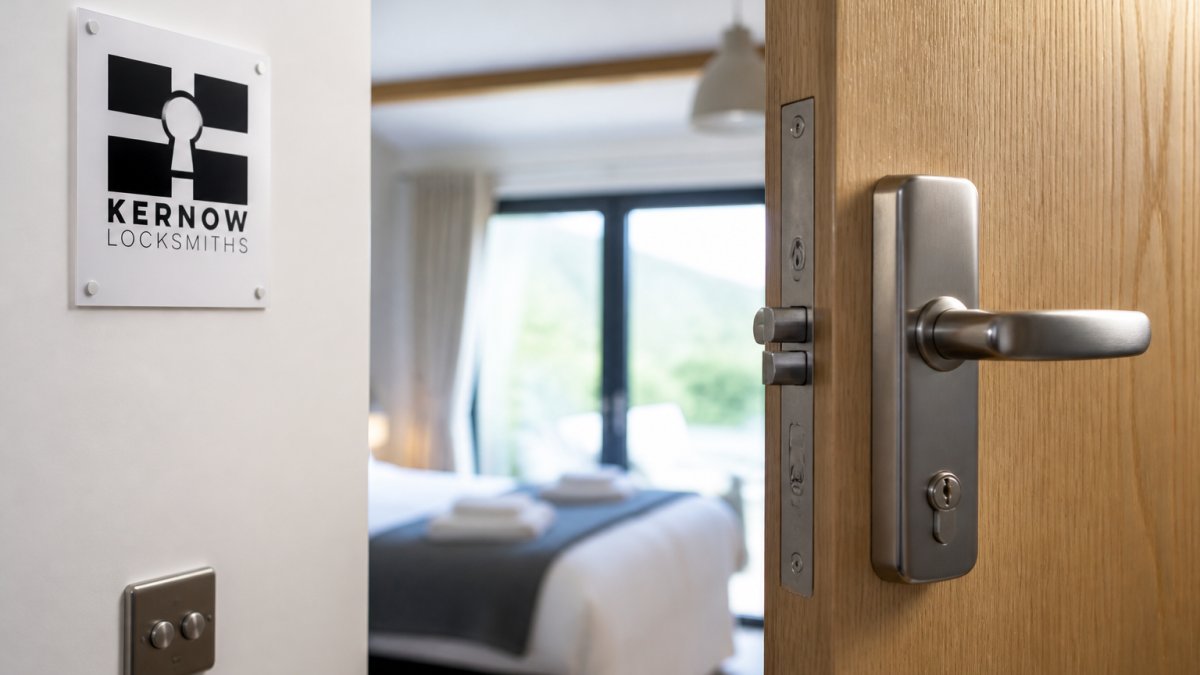
Fire safety lock requirements for holiday lets require that the final exit door opens from the inside without a key, a tool or specialist knowledge, so a thumb-turn lock satisfies the rule while a key-operated deadbolt on the inside face fails it. Guests must be able to leave in one motion, and at least one window per bedroom should open from the inside without a key.
Last Updated: November 2, 2026
Quick Summary
- The Regulatory Reform (Fire Safety) Order 2005 makes the responsible person legally accountable for fire safety in England and Wales.
- A deadlock fitted for insurance purposes is the most common cause of a failed egress check, so specify a thumb-turn version.
- Smoke alarms belong in escape routes and high-risk rooms, with carbon monoxide alarms wherever there is a gas, oil or solid fuel appliance.
- Keep a compliance file with the risk assessment, alarm test logs, appliance service records and lock hardware receipts.
- Walk the escape route at night and fix any point where a guest would need a key, code or memory to get out.
Table of Contents
- Fire Safety Lock Requirements for Holiday Lets: The Legal Framework
- Holiday Let Door Lock Requirements for a Safe Escape
- How to Complete a Holiday Let Fire Risk Assessment
- Keyless Entry for Holiday Lets: Convenience Versus Compliance
- Your Holiday Let Fire Safety Checklist
- Guest Instructions, Key Management and Evidence of Compliance
- Booking a Lock and Fire Safety Review With Kernow Locksmiths
- Frequently Asked Questions
Fire Safety Lock Requirements for Holiday Lets: The Legal Framework
Fire safety lock requirements for holiday lets sit at the intersection of two duties: keeping paying guests secure and letting them out fast in an emergency. Guests must be able to open the final exit door from the inside without a key, and that single rule shapes almost every lock decision you make. This guide separates the legal duties from best practice so you can specify hardware with confidence.
The governing legislation is the Regulatory Reform (Fire Safety) Order 2005, which applies in England and Wales and makes the person responsible for the premises, the "responsible person", legally accountable for fire safety. For proof of fire and insurance approval on the locks you are required to fit, see Insurance / Fire Approval - Kernow Locksmiths. The official Fire Safety Order guidance for small premises sets out the core duties in plain terms.
What Is a Legal Duty and What Is Guidance
The distinction matters because it tells you where a mistake is a breach and where it is simply a missed improvement. In England and Wales, the Fire Safety Order imposes duties: a fire risk assessment, general fire precautions, and means of escape that are adequate and maintained.
In practice, the rule that guests must be able to open the final exit door from the inside without a key is treated as a core means-of-escape requirement across the UK.
How the Four Jurisdictions Differ
| Jurisdiction | Main fire safety regime | Lock and egress position |
|---|---|---|
| England and Wales | Regulatory Reform (Fire Safety) Order 2005 | Responsible person duty; final exit must open from inside without a key; guidance for sleeping accommodation sets the benchmark |
| Scotland | Fire (Scotland) Act 2005 and associated regulations, with separate guidance for holiday accommodation | Similar egress principle; check the Scottish guidance for the specific lock and alarm expectations |
| Northern Ireland | Fire and Rescue Services (Northern Ireland) Order 2006 and associated regulations | Similar egress principle; enforcing authority guidance sets out expectations for guest accommodation |
A template written for an English cottage should not be applied to a Scottish let without checking the Scottish guidance, and vice versa. The underlying principle, no key needed to get out, is consistent, but the paperwork, the enforcing authority and some alarm expectations are not.
Which Properties and Accommodation Types Are Covered
Almost every form of paid guest accommodation falls within scope: self-catering cottages, converted barns, flats let for short breaks, rooms let through booking platforms, bunkhouses and larger holiday parks.
A common mistake is assuming a single-unit let is exempt because it feels like a normal home. The moment you take paying guests, the responsible person duties attach, and the fire safety guidance for premises providing sleeping accommodation treats guest accommodation as a distinct risk category.
Watch out: treating a let as "just a house" is the single most common route to non-compliance, because domestic assumptions about locks and alarms do not survive contact with paying guests.
Small Holiday Lets and Scope Thresholds
Small holiday lets are not automatically outside the law, but the guidance is proportionate. A single-unit let sleeping a small number of guests faces a lighter assessment than a multi-unit site, yet the fundamentals do not change: a working detection system, a clear escape route, and exit doors that open without a key.
A property sleeping two on one floor is a simpler assessment than one sleeping eight across three floors with a basement. Scale your documentation and hardware to the risk, not to a number on a form.
Holiday Let Door Lock Requirements for a Safe Escape
Holiday let door lock requirements come down to one non-negotiable: the final exit door must open from the inside without a key, a tool or specialist knowledge.
Final Exit Doors, Deadbolts and Thumb-Turn Locks
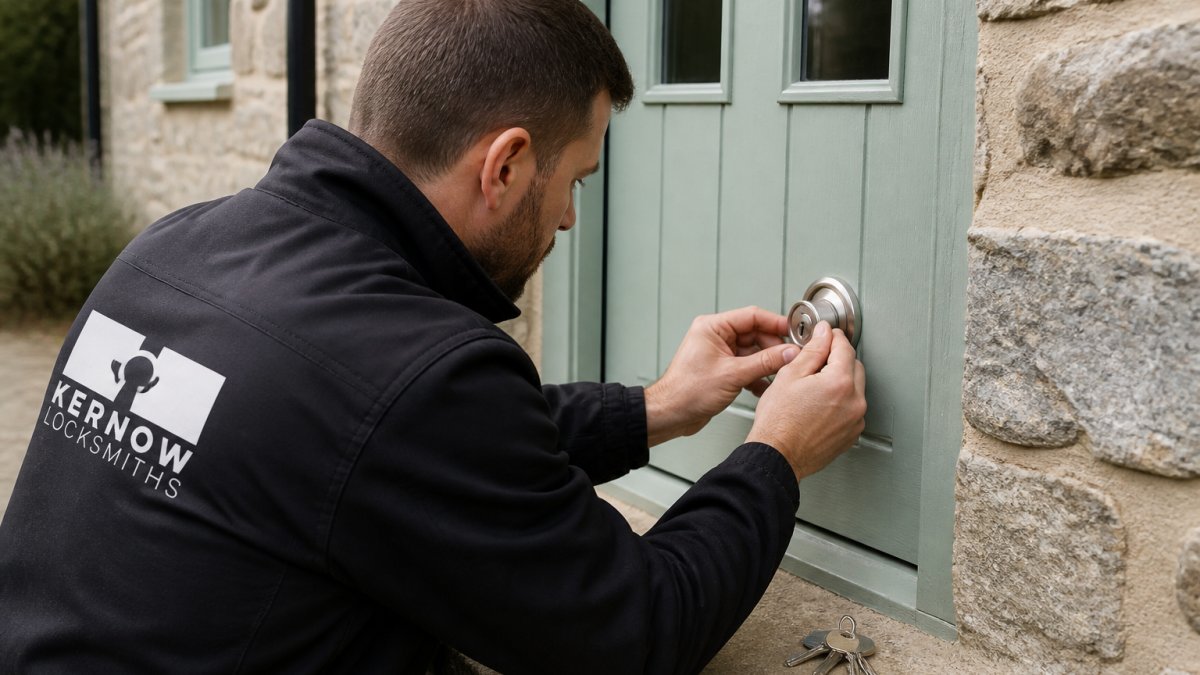
The distinction that matters is between security on the outside and egress on the inside. A deadbolt is fine on the external face; the internal mechanism must be a thumb-turn.
The practical test is the "one motion" rule. A guest should be able to leave through the final exit door by operating a single handle or thumb-turn, without a key, without a code and without reading instructions. For a deeper comparison of lock types and security standards, read the best door locks for home security guide.
| Lock type | Typical location | Egress implication | Safer specification |
|---|---|---|---|
| Key-operated deadbolt, key on inside | Final exit door | Fails, guest needs a key to leave | Replace internal side with thumb-turn cylinder |
| Thumb-turn deadbolt | Final exit door | Passes, one motion to open | Keep; check the thumb-turn is reachable and not stiff |
| Night latch with internal knob | Final exit door | Usually passes if the knob retracts the latch | Confirm the latch retracts fully with one turn |
| Multipoint lock with lever handle | Final exit door | Passes only if the handle opens the door without a key | Check the lever operates the full locking strip in one action |
| Euro cylinder with thumb-turn | Final exit door | Passes if the thumb-turn is on the inside face | Fit a thumb-turn cylinder rather than a key-only cylinder |
| Padlock or hasp on an escape door | Outbuilding or side gate on the route | Fails, needs a key or tool | Remove from any door on the escape route |
| Key-operated window lock | Bedroom escape window | Fails if the key is not left in place | Use a lock that opens from inside without a key, or leave the key in a known position |
Two further points catch owners out. First, a thumb-turn that has been painted over, is stiff, or is mounted too high for a child or a guest with limited reach is not compliant in practice even if it is compliant on paper. Second, a door locked from the outside when guests are out is fine; a door locked from the outside while guests are in is not, so never rely on an external-only lock as the sole means of securing the property during a stay.
Windows, Internal Doors and Accessible Evacuation
Windows matter less for locks than for escape: at least one window per bedroom should be openable from the inside without a key.
Internal doors along the escape route should not be locked in a way that traps guests, and any door that must stay secure should use hardware a guest can operate in the dark.
Accessibility changes the specification. Guests with limited mobility, or families with young children, need exit hardware that works with a single motion and at a reachable height.
How to Complete a Holiday Let Fire Risk Assessment
A holiday let fire risk assessment is a documented review of what could start a fire, who could be harmed, and what you have done to reduce the risk. It is a legal duty for the responsible person, not a box-ticking exercise, and it must be reviewed when the property or its use changes. The government fire risk assessment guidance for small premises provides a workable template.
- Identify fire hazards: cooking, heating, open fires, solid fuel burners, and any gas or oil appliances.
- Identify people at risk: guests unfamiliar with the layout, children, and anyone with mobility needs.
- Evaluate and remove risk: service appliances, clear clutter, and confirm escape routes are unobstructed.
- Record findings and actions: write down what you found and what you changed.
- Review and update: revisit after refurbishment, a change in guest numbers, or a near miss.
Alarm Placement, Detection and Testing
Detection is where most small lets get it wrong. Smoke alarms belong in escape routes and high-risk rooms, and carbon monoxide alarms are needed wherever there is a gas appliance, oil appliance, or solid fuel burner.
| Area | Detection | Testing Frequency |
|---|---|---|
| Escape route and hallways | Smoke alarm | Weekly test, annual check |
| Living room | Smoke alarm | Weekly test |
| Room with gas, oil or solid fuel | Carbon monoxide alarm | Weekly test |
| Bedrooms | Consider smoke alarm | Weekly test |
Keyless Entry for Holiday Lets: Convenience Versus Compliance
Keyless entry for holiday lets solves the key-handover problem, but it introduces a compliance question: does the lock still allow a one-motion escape? A smart lock that requires a code or app to open from the inside fails the egress test.
Our same-topic guide on hiring a locksmith for holiday rental security covers what to ask and how to vet a provider before you commit to a keyless system.
Your Holiday Let Fire Safety Checklist
A holiday let fire safety checklist turns the legal duties into a repeatable routine. Use it at every changeover and before each season.
- Final exit door opens from inside without a key
- Thumb-turn fitted to all final exit doors
- Smoke alarms tested and logged
Guest Instructions, Key Management and Evidence of Compliance
Compliance is only as good as the evidence behind it. Keep a simple file: the risk assessment, alarm test logs, service records for appliances, and receipts for any lock hardware fitted.
Guest information should state the escape route in plain language and explain how to open the final exit door. Key management should never leave a guest reliant on a key to get out.
Booking a Lock and Fire Safety Review With Kernow Locksmiths
Getting the hardware right is the part most owners put off, and it is the part that matters most when something goes wrong. Our professionally trained locksmiths can help with lock work for residential and commercial properties. We offer 24 hour emergency service. Get in touch with our team to discuss your requirements.
Frequently Asked Questions
What are the fire safety requirements for holiday lets?
Under the Fire Safety Order, the responsible person for a holiday let must carry out a fire risk assessment, keep escape routes clear, and make sure guests can leave the building without needing a key. That means fire detection and alarms, a means of escape that opens easily from the inside, and clear guest instructions. You also need to review the assessment when anything changes, such as a new layout, a new gas appliance or a change in sleeping capacity.
Can a holiday let door have a key-operated lock?
A key-operated lock is fine on the main entrance from the outside, but it must not stop anyone getting out. Fit a thumb-turn or handle on the inside face of final exit doors so a guest can open the door without hunting for a key in the dark. Deadbolts that need a key on both sides are a common failure point in a fire.
Are smart locks suitable for holiday lets?
Keyless entry for holiday lets works well for guest access, but it adds a duty. The lock must fail safe in a fire, keep a mechanical override, and stay operable if the battery dies or the network drops. Choose a model with a clear thumb-turn on the inside and a documented battery-low warning. Test the inside handle yourself before every changeover, and keep a physical key in a key safe as a backup.
Do holiday lets need fire doors?
A fire risk assessment decides this, not a blanket rule. A small single-storey let with a direct exit may need nothing more than a well-fitted door that closes properly. A larger property with bedrooms off an internal staircase often needs fire doors to protect the escape route. Your assessment should record the reasoning, and any fire door fitted needs intumescent strips, a self-closer and hardware that opens from the inside without a key.
What should a holiday let fire risk assessment cover?
It should identify the people at risk, including guests who do not know the building, and record the fire hazards present, such as cooking, open fires, solid fuel burners and gas appliances. It then sets out the detection, escape routes, signage and door hardware that control those risks. Record who completed it, the date, and the review trigger. Keep a copy on site or with the management company so it can be shown on request.
How often should fire safety equipment and door locks be checked in a holiday let?
Test smoke and carbon monoxide alarms at every changeover, and log the result. Check that final exit doors open freely with one action, that thumb-turns turn smoothly, and that no guest has left a key in an inside lock. A fuller inspection of locks, hinges, self-closers and fire blankets fits well with a quarterly maintenance visit, and any change to the property should trigger a risk assessment review.
The gap between a compliant let and a risky one usually comes down to one lock on one door. Kernow Locksmiths can review your escape doors, fit thumb-turn hardware, and confirm your locks meet the standards your insurer and your guests depend on. Get started with Kernow Locksmiths and give every guest a door they can open in the dark.


